About us
Our approach
"If children can't learn the way we teach, we need to teach in the way they learn." — Ignacio Estrada
We believe everyone has the right to evidence-based, effective support with the things they find challenging. Every child has different needs, which is why we use a range of individualised, child-centred and evidence-based techniques. More important than any label, it is the child and their community at the heart of everything we do.
Our primary approach is derived from the science of Applied Behaviour Analysis (ABA), which looks at learning from an individual perspective — taking into account a person's experiences, strengths and needs to understand how they learn best. You can find out more from our regulatory authority, the UK Society for Behaviour Analysis.
Naturalistic Developmental Behavioural Interventions
We use a particular branch of ABA — NDBI — which combines behavioural and developmental approaches to early intervention, drawing on ABA and Developmental Psychology.
Behavioural components
- Environmental arrangement
- Direct teaching
- Prompting
- Reinforcement
- Shaping
- Joint Activity Routines (JARs)
Developmental components
- Following the developmental sequence
- Utilising a child's natural environment
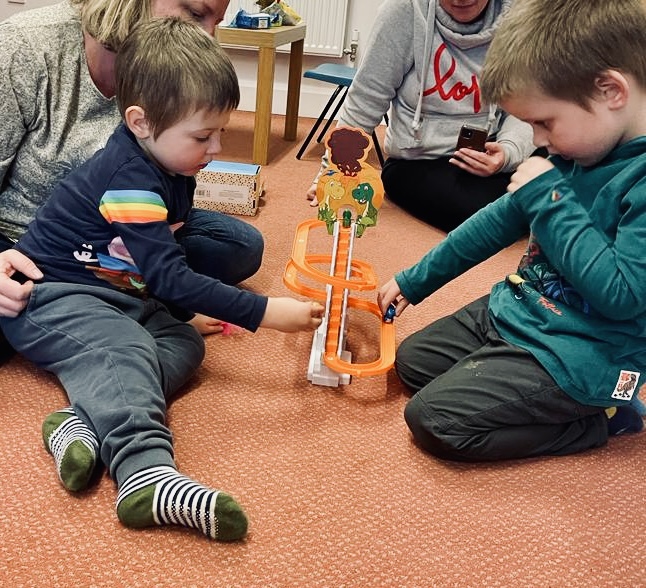
- Following the child's lead
- Joint engagement
- Relationship building
Established NDBIs
- Early Start Denver Model (ESDM)
- Pivotal Response Treatment (PRT)
- JASPER (Joint Attention, Symbolic Play, Engagement and Regulation)
In our sessions we use
- Naturalistic teaching
- Environmental adaptations
- Positive reinforcement
- Visual supports
- Alternative communication
- Functional behaviour assessment
- Predictability and routines
- Prompting and prompt fading
Learn more: NDBI video · Journal article


Our ethos
- We involve children and families in the process and work with their preferences, helping children gain life skills and ultimately advocate for themselves.
- We do not believe in changing someone's identity to help them fit in with society.
- We do not support or align ourselves with organisations that use aversive procedures.
- We believe in listening to autistic voices and being sensitive to the populations we serve.
- We respect cultural, neurological and ethnic diversity.
Our stance on the 'controversy' around ABA
As with every science, ABA has evolved. As our understanding of neurodiversity has improved, so has the practice of behavioural interventions. Here we counter some common misconceptions:
Myth 1
"ABA is a treatment for autism"
ABA is not a therapy or treatment for autism. It is a science — the science of how we learn. Our practice uses science to support our learners.
Myth 2
"ABA only teaches rote learning"
ABA is much more than this! Practitioners understand how people learn and can use this to teach anything, including problem solving, understanding emotions and expressing individuality. We strive for generalisation, so new skills can be used in a child's everyday life.
Myth 3
"ABA tries to normalise people"
A big fat NO from us! Whilst scientists in the 60s and 70s used behaviour modification to change people, the science and its regulation have evolved, and practitioners now follow a strict ethical code which prevents anything that is not in the individual's best interest.
Myth 4
"ABA uses bribes"
Positive reinforcement is not a bribe. Reinforcement means actions are more likely to be repeated if something preferred happens afterwards. Bribery is offering something to make someone stop doing something undesired.
Ethical codes: BACB · UKSBA. Further reading: Behaviour Analysis: Fact or Fiction · Autism Science Foundation